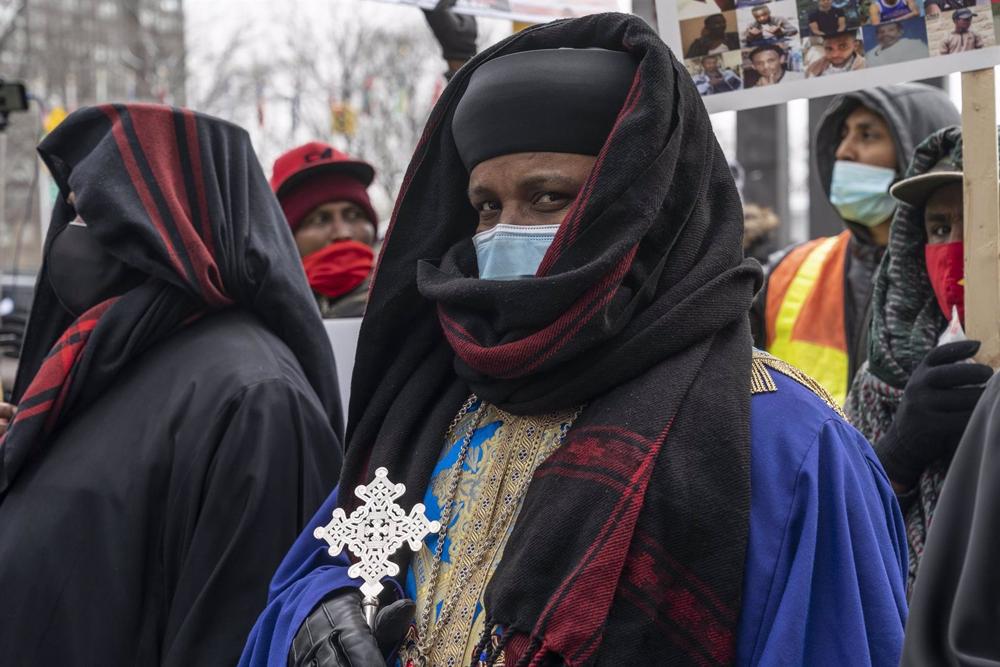
The Ethiopian government is facing a new crisis after the country’s Orthodox Church denounced Prime Minister Abiy Ahmed for backing an unrecognized split, amid protests and attacks such as the one that left eight dead last weekend in a church in West Arsi, in the Oromia region, the country’s largest and the epicenter of this crisis.
The tension began on January 22, when three Orthodox bishops declared the creation of the so-called Holy Synod of Oromia, Nations and Nationalities, formed in principle by 25 episcopates. All of them were fulminantly excommunicated three days later by the main branch, the Holy Synod of the Ethiopian Orthodox Tewahedo Church, followed by some 50 million faithful throughout the country.
Behind the split was Archbishop Abune Sawiros, who explained his decision to dissociate himself from the Tewahedo Church, considering that its leaders had done nothing to offer religious services in the tribal languages, which had led to the loss of millions of faithful in recent years in Oromia and the Southern region.
The Ethiopian prime minister initially tried to distance himself from the crisis, which he described as an internal affair, and called on the leaders of the two branches to resolve their differences. These comments sparked the ire of the Tewahedo synod, which accused the Oromo and Protestant leader of distorting the crisis by describing it as a personal conflict.
«We find it particularly disturbing that the Prime Minister let it be understood that this synod is opposed to the mass in the Oromo language, something that is far from reality,» according to a letter sent earlier this month by the Tewahedo Church and signed by Patriarch Abune Mathias, Orthodox leader, who has announced the beginning of mass mobilizations from the capital, Addis Ababa, next Sunday.
The events were precipitated on February 4 when, according to the Ethiopian Human Rights Commission, a panel of independent specialists, at least eight people died at the hands of «Ethiopian security forces aid workers» who used «disproportionate force» to disperse an attempt to occupy the church of St. Michael the Archangel.
The same commission, in its report published this Friday, denounces a campaign of repression against followers of the Tewahedo Orthodox Church who have opposed the creation of this new synod, and who have been victims of «beatings, intimidation, expulsion from churches and extrajudicial arrests».
Internet access in much of the country has been slowed down in recent hours amid protests over the crisis, while schools in the country’s capital, Addis Ababa, have closed their doors on Friday due to the tense atmosphere in the city ahead of what could end up being, next Sunday, a clash of groups of demonstrators for and against the excommunicated bishops.
Meanwhile, Ethiopia’s Joint Security and Intelligence Task Force, which comprises the country’s main security agencies, has warned both groups to refrain from calling for unauthorized demonstrations in the capital and other parts of the country, to deliberately «create disturbances» among the faithful, according to a statement reported by the ‘Addis Standard’.
Source: (EUROPA PRESS)