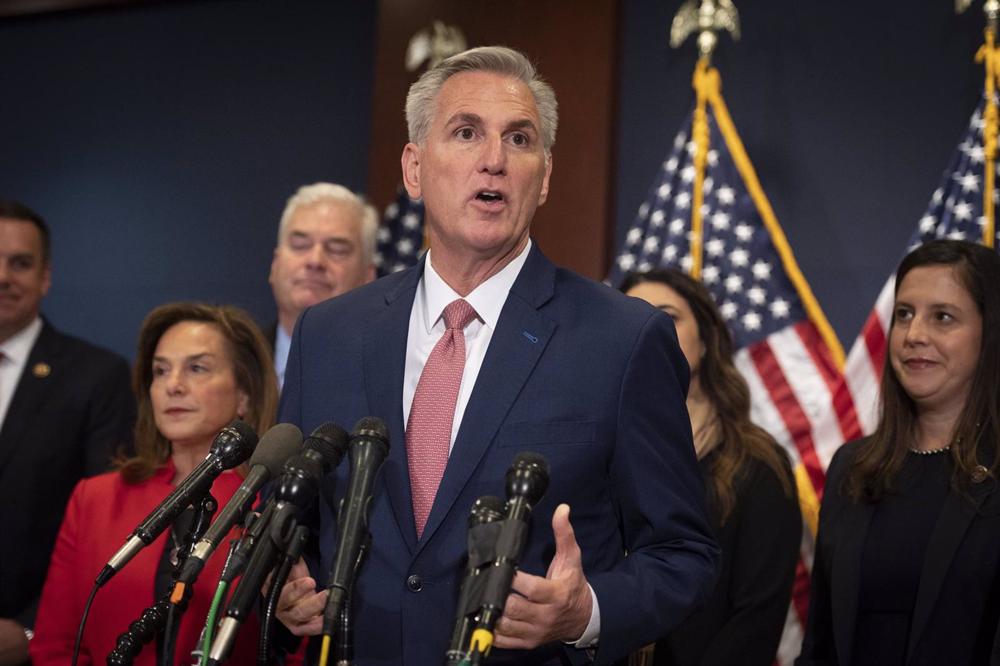
Republican leader Kevin McCarthy failed Tuesday to secure the necessary support to become speaker of the U.S. House of Representatives, marking the first time since 1923 that a second vote has had to be held.
Republicans won only 222 seats after the midterm elections, far worse results than they had anticipated, leaving McCarthy little room for error to reach the 218 votes he needs.
Thus, the former Republican minority leader has managed to garner only 203 Republican votes on the first ballot, while Democrats have unanimously supported their leader, New York Representative Hakeem Jeffries, giving him 212 ‘yeses’, as reported by Bloomberg.
The blockage in the conservative wing has occurred when several congressmen have voted for the Republican representative of Arizona, Andy Biggs, who has defended in his official Twitter profile that McCarthy «should retire» and allow «to select someone else in the next vote».
McCarthy’s failure has exposed, as reported by the newspaper ‘The New York Times’, the deep divisions of the Republicans, although they have not put an end to the candidacy of the representative from California to the presidency of the House, who has promised to continue, even if it is by forcing multiple votes until he achieves the position.
This group of Republicans who did not vote for McCarthy on the first ballot are considering voting for Republican Representative Jim Jordan in the second round, according to sources with knowledge of the matter told CNN.
House rules, however, are clear: the process will have to be repeated until McCarthy, or a different candidate, gets the necessary 218 votes. The last time the election was deadlocked was in 1923, when Massachusetts Republican Frederick Gillett was elected on the ninth ballot.
Source: (EUROPA PRESS)